


The Science of Mid-Life Fatigue: Why Men Over 40 Feel Exhausted and What Actually Works
The Silent Energy Crisis No One Talks About
Let's be honest: if you're a man over 40, you've probably noticed something's changed. That afternoon slump hits harder. Weekend recovery doesn't quite cut it anymore. You're not imagining it—and you're definitely not alone.
Studies show that over 75% of men between 40-50 report frequent fatigue, yet fewer than one in four actually do something about it. This "silent exhaustion" is quietly eroding quality of life for millions of men who simply power through, thinking it's just part of getting older.
The Wake-Up Call: When "Pushing Through" Stops Working
At 42, after a decade in content marketing, I thought I knew fatigue. Late nights, tight deadlines—nothing I couldn't handle. But somewhere around 39, the rules changed.
💭 Last year's company party was my wake-up call. An hour in, while colleagues were just getting started, I was scanning for the exit. In my early 30s, I could game all night and still crush it the next day. Now, a single late night leaves me wiped for days.
Sound familiar?
When I finally got a full checkup, everything came back "normal"—technically. But my doctor's words stuck with me:
"Your numbers are all within range, but they're all at the edge. If you don't make changes now, they won't be 'normal' in two years."
That's the nature of sub-optimal health—not quite sick enough for a diagnosis, but your body is clearly sending distress signals.
The Science: What's Actually Happening After 40
I spent two weeks diving into research papers and medical literature. Here's what I found.
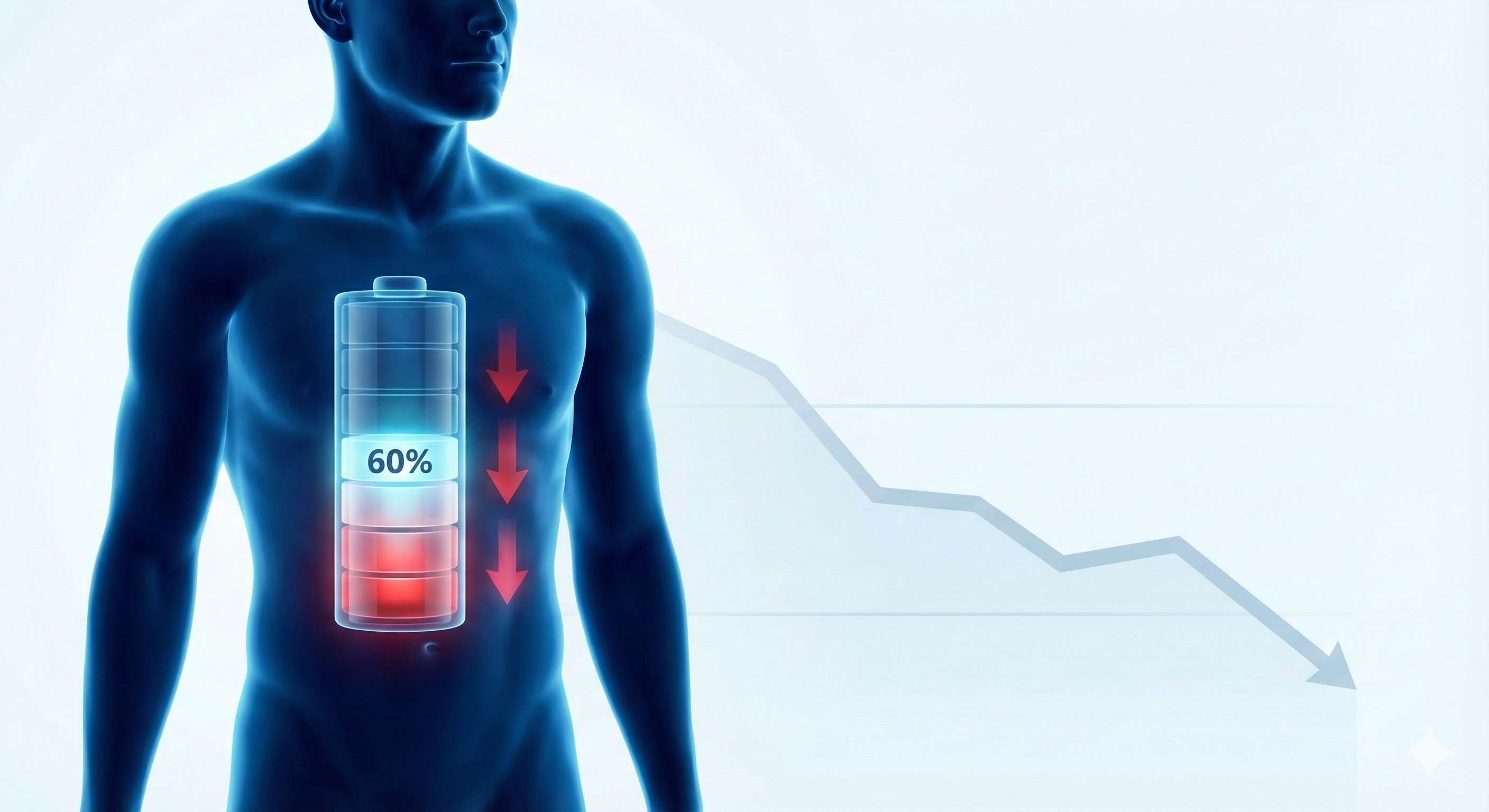
▲ After 40, your body's energy reserves decline year over year as metabolic efficiency drops
The Testosterone Decline
This was the biggest surprise for me. Testosterone isn't just about libido—it's fundamentally linked to energy, muscle maintenance, and mood stability.
The Massachusetts Male Aging Study (MMAS)—a landmark research project tracking hormonal changes in men—found that testosterone levels decline approximately 1.6% per year starting around age 30.
Sounds small? Look at the cumulative effect:
Low testosterone symptoms include:
- Persistent fatigue
- Reduced muscle strength
- Difficulty concentrating
- Mood changes—irritability or low mood
- Decreased libido
Metabolic Slowdown
Remember when you could eat anything without consequences? Your Basal Metabolic Rate (BMR) is the reason that's changed.
Research shows BMR declines by approximately 3-5% per decade after age 30. This means:
▲ Less Efficient Energy Conversion
Same food intake produces less usable energy
🔥 Easier Fat Storage
Especially visceral fat around the midsection
⏱️ Longer Recovery Time
Your body takes longer to bounce back
💪 Higher Energy Cost
Same tasks require more "reserves"
The Chronic Stress Factor
Modern life hits men in their 40s with a triple whammy: career pressure, family responsibilities, and financial obligations. This constant stress keeps cortisol (the stress hormone) chronically elevated.
Short-term cortisol helps you handle challenges. Long-term elevation wreaks havoc:
Chronic stress is like a slow leak—you don't notice until you're running on empty.
📊 The Numbers That Changed My Perspective
According to health surveys, among men aged 40-50:
Most men just tough it out, thinking "it'll pass." But here's the thing: it doesn't get better on its own.
What I Tried: Dead Ends and What Actually Worked
After understanding the science, I started making targeted changes. Full disclosure: I made plenty of wrong turns first.
Step 1: Sleep Optimization
What I did: Forced myself to bed by 11 PM, added 15 minutes of morning stretching.
Results: ★★★☆☆
One month in, I noticed improvement—but limited. Work demands don't always cooperate with ideal sleep schedules.
- Keep consistent sleep/wake times—even on weekends
- No screens 90 minutes before bed
- Keep bedroom temperature at 65-68°F (18-20°C)
- Consider melatonin or magnesium supplements (consult your doctor first)
Step 2: Exercise
What I did: Got a gym membership. Planned to go three times a week.
Results: ★★★☆☆
Reality check: Month one, went 8 times. Month two, 3 times. Month three, couldn't find my membership card. After a full day of work, dragging yourself to the gym feels impossible.
WHO recommends at least 150 minutes of moderate aerobic activity per week. For men over 40, consider adding:
| Resistance Training | Squats, deadlifts, bench press | Stimulates testosterone production |
| HIIT | 20-minute high-intensity intervals | Maximum results, minimum time |
| Recovery Exercise | Swimming, yoga | Helps body repair |
I switched to weekend swimming—much easier to maintain.
Step 3: Targeted Supplementation
What I did: Started skeptical, tried several products.
Results: ★★★★☆
I initially dismissed supplements as expensive placebos. But research showed that after 40, certain nutrients become harder to get from diet alone—and harder for your body to absorb.
💭 Honestly, I was cautious. This category has a lot of questionable products—news reports regularly expose supplements with undisclosed pharmaceutical ingredients. I did serious research, focusing on two things: natural ingredients and third-party testing certifications.
| Zinc | Essential co-factor for testosterone synthesis | Oysters, beef, supplements |
| Vitamin D | Positively correlated with testosterone levels | Sunlight, fish, supplements |
| Ginseng Extracts | Traditional adaptogen for vitality support | Standardized extracts |
| Maca | Research supports energy and stamina benefits | Powder or capsules |
Why I Chose CP-101 PRIVITAL

▲ With the right approach, reclaiming your energy is absolutely possible
A friend in the medical device industry suggested looking at Japanese supplements—he mentioned Japan's reputation for rigorous quality control and deep research into men's health. After extensive comparison, I chose CP-101 PRIVITAL.
Not because of marketing claims—but because of verifiable credentials:
CP-101 PRIVITAL Safety Certifications
⚠️ Important Safety Note
Some men's products on the market contain undisclosed pharmaceutical ingredients (like sildenafil), which pose serious cardiovascular risks.
Any product promising "immediate" or "dramatic" results should raise red flags. Genuine, safe improvement takes time.
My Experience Timeline
Let me be clear: this isn't an overnight solution.
I can't attribute this entirely to PRIVITAL—I was also sleeping better and swimming on weekends. But this combined approach has delivered the most noticeable improvement I've experienced.
Straight Talk for Men in the Same Boat
Based on my experience and the science, here's my honest advice for men over 40:
1. Stop Ignoring the Signals
Your body is telling you something. At 40+, you can't power through like you used to. Fatigue is your body demanding a course correction.
2. Use a Multi-Pronged Approach
Sleep, exercise, nutrition—they work together. No single solution will get you there. And what works for someone else might not work for you.
3. Be Patient
Real change takes 4-8 weeks to become visible. Anyone promising transformation in days is selling fantasy.
4. Choose Products Carefully
Question anything claiming "miracle results." Look for legitimate certifications and third-party testing.
5. Get Annual Checkups
Monitor these key markers:
- Testosterone levels
- Fasting glucose and HbA1c
- Liver function (ALT, AST)
- Full lipid panel
The Bottom Line
Fatigue after 40 isn't destiny—it's your body asking for smarter management. By understanding the underlying biology—testosterone decline, metabolic slowdown, stress accumulation—you can make targeted changes that actually work.
If you're dealing with similar struggles, I hope my experience offers some useful direction. Everyone's situation is different, and my approach may not be a perfect fit for you. But here's what I know for sure: this is a solvable problem. You don't have to keep grinding through it.
Start Today
Optimize Sleep · Stay Active · Supplement Smart
Your body deserves better than just getting by.
📌 Frequently Asked Questions
Q: Why do men over 40 often feel chronically tired?
A: Three main factors: 1) Testosterone naturally declines ~1.6% per year after 30 (per the Massachusetts Male Aging Study); 2) Basal metabolic rate drops 3-5% per decade, reducing energy efficiency; 3) Chronic stress keeps cortisol elevated, leading to burnout. These factors compound over time.
Q: What makes Japanese supplements different?
A: Japan has a reputation for strict GMP manufacturing standards, precise formulations, and comprehensive quality control systems. For CP-101 PRIVITAL specifically, it carries FDA facility registration, SGS certification, and testing from the Japan Food Analysis Center—providing multiple layers of verification.
Q: How can I tell if a supplement is safe?
A: Check five things: 1) Legitimate manufacturing licenses; 2) Third-party certifications (SGS, etc.); 3) No-pharmaceutical-additives testing reports; 4) GMP-compliant facilities; 5) Traceable company information. The FDA has specifically warned consumers about supplements containing undisclosed pharmaceutical ingredients.
Q: How long before I see results from supplements?
A: Based on my experience and industry norms, natural supplements typically take 2-4 weeks to show initial effects, with more substantial improvements around 1-2 months. Be skeptical of anything claiming instant results—that's often a red flag for undisclosed pharmaceutical ingredients.
Scientific References
- Feldman, H. A., et al. (2002). "Age Trends in the Level of Serum Testosterone and Other Hormones in Middle-Aged Men: Longitudinal Results from the Massachusetts Male Aging Study." The Journal of Clinical Endocrinology & Metabolism, 87(2), 589-598.
- Ravussin, E., et al. (1988). "Reduced Rate of Energy Expenditure as a Risk Factor for Body-Weight Gain." New England Journal of Medicine, 318(8), 467-472.
- McEwen, B. S. (2008). "Central effects of stress hormones in health and disease." European Journal of Pharmacology, 583(2-3), 174-185.
- World Health Organization. (2020). "WHO Guidelines on Physical Activity and Sedentary Behaviour." Geneva: WHO.
- Gonzales, G. F., et al. (2002). "Effect of Lepidium meyenii (Maca) on sexual desire and its absent relationship with serum testosterone levels in adult healthy men." Andrologia, 34(6), 367-372.
- U.S. Food and Drug Administration. (2019). "Tainted Sexual Enhancement Products." FDA Consumer Updates.
Disclaimer: This article is for informational purposes only and does not constitute medical advice. Individual circumstances vary—consult a healthcare professional for personal guidance. Product information is based on publicly available data; refer to official product documentation for complete details.